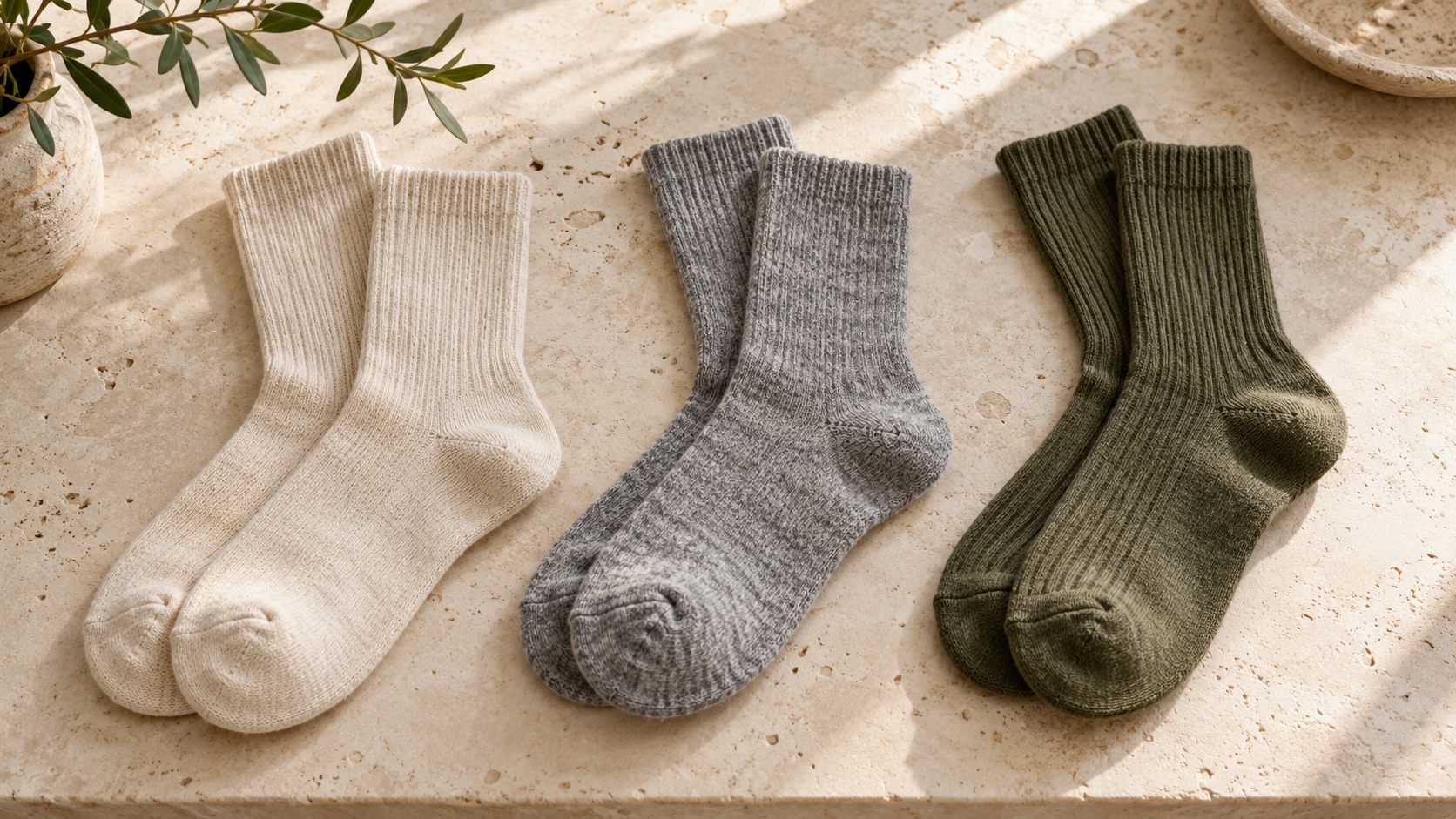
Shopping for natural-fiber socks sounds straightforward until you start reading the labels. Merino wool socks often contain nylon. Organic cotton socks may include polyester and spandex. And a pair made without elastic may fit differently from the socks you already own.
Those differences matter. Socks need to stretch over your foot, stay comfortably in place, and withstand repeated rubbing inside a shoe. The materials that help them do those things aren’t always natural.
A useful starting point is to decide what you want: more natural fiber against your skin, a sock made entirely from natural fibers, or construction that avoids plastic throughout. Each goal leaves you with different choices—and some practical tradeoffs.
Start with how you’ll wear them
Before comparing fiber percentages, think about the job.
For everyday wear, you might prioritize a comfortable cuff, a smooth toe seam, and a weight that fits your shoes. For hiking or running, staying securely in place and resisting wear may matter more. Around the house, a relaxed sock may suit you perfectly.
Fiber content is part of that decision. So are thickness, knit, sizing, and the shoes you wear over it. A bulky sock that crowds your toes is a poor match, however appealing its materials.
Cotton and wool are useful starting points
Cotton
Cotton is worth considering if you prefer a plant-based fiber or want an everyday sock without wool. Both cotton blends and options sold as 100% cotton are available.
Check the complete description, though. An “organic cotton” headline doesn’t tell you what percentage of the sock is cotton or whether the cuff contains elastic.
Moisture performance also depends on the finished fabric. Cotton Incorporated’s TransDRY technology, for example, changes how cotton yarns handle moisture. Broad descriptions such as “breathable” don’t tell you everything about a sock’s construction or treatments. Source: CottonWorks.
Wool and merino
Wool, including merino, is a useful starting point for cooler weather, travel, and active use. Woolmark describes wool’s breathability and odor resistance, while its technical sock guide explains how knitting, cushioning, and reinforcement contribute to performance. Sources: Woolmark care guide, Woolmark sock construction guide.
But “merino” doesn’t mean the whole sock is wool. Read the percentages, and consider weight and fit alongside the fiber name.
What are the performance tradeoffs?
The distinction that matters most is often between a sock made mostly from natural fibers and one made without synthetic fibers or added elastic.
A merino blend designed for hiking may feel quite different from an elastic-free cotton sock. It would be misleading to treat both as one category with the same performance.
Stretch isn’t the same as staying in shape
A knitted sock can stretch because of the way its loops are constructed. What matters during wear is also how well it returns to shape.
An elastic-free cotton sock may feel more relaxed and less closely fitted than a sock made with elastane. Rawganique acknowledges this in its CANALTOWN listing, describing natural stretch from the knit while noting a less tight fit than nylon or polyester socks. Source: Rawganique.
That doesn’t mean every elastic-free sock will fall down. It does mean you shouldn’t assume it will have the familiar hold of a stretch-blend athletic sock.
If you prefer a snug fit through the heel and arch, this is worth paying attention to before buying several pairs.
Reinforcement serves a purpose
Nylon and elastane aren’t always incidental additions.
Manufacturers use nylon to improve wear resistance and elastane—also called spandex—to help provide stretch and recovery. Darn Tough describes using both alongside merino for durability and fit. Woolmark’s technical sock guide also describes nylon reinforcement for abrasion resistance. Sources: Darn Tough, Woolmark sock construction guide.
Avoiding those additions may involve a tradeoff in shape retention or wear resistance. That is a consideration to investigate, rather than proof that a particular all-natural pair will wear out sooner. Yarn quality, knit density, reinforcement design, fit, and care also influence how it holds up.
Match the compromise to the activity
For casual wear or relaxing at home, you may welcome a less restrictive fit. For running, long walks, or hiking, you may place greater value on a sock that stays closely fitted without frequent adjustment.
When trying an elastic-free pair, notice whether it:
- Slips at the heel or slides down inside your shoe.
- Bunches beneath your foot.
- Becomes noticeably looser during wear.
- Feels too bulky in your usual footwear.
These observations are more useful than assuming the highest natural-fiber percentage will always make the best sock for your needs.
We haven’t wear-tested the examples in this guide. Their material descriptions explain the choices available; they don’t establish how each pair will perform on your feet.
How much synthetic fiber are you comfortable with?
Consider an illustrative label:
70% wool, 28% nylon, 2% elastane
Most of the fiber is wool, but 30% is synthetic. That may fit your goal of wearing more natural fiber. If your goal is to avoid synthetic fibers entirely, it won’t.
There is no single percentage that makes a sock the right purchase for everyone. A mostly natural blend may offer the fit you prefer, while an elastic-free option may better match your material priorities.
Look at the full composition and decide whether the remaining materials serve a purpose you value.
Read beyond the front of the package
Start with the fiber breakdown, then check the details about the cuff, heel, toe, and seams.
Under U.S. labeling guidance, certain components can be excluded from the main fiber declaration. The FTC also gives examples of separate disclosures for elastic and fibers added to reinforce a sock’s heel or toe. Read any qualifications alongside the percentages. Source: FTC textile and wool labeling guidance.
Watch for wording such as:
| Label or description | What to check |
|---|---|
| Organic cotton | The cotton percentage and any other fibers |
| Exclusive of elastic | What the elastic contains |
| Reinforced heel and toe | Which material provides the reinforcement |
| Latex-free | Whether nylon, polyester, or elastane is still present |
| Non-binding | Whether this describes the fit, the materials, or both |
If avoiding plastic throughout is your priority, ask about the yarns, cuff, joining thread, and any grip coating. Packaging is a separate question.
A few places to start
These examples show different approaches to sock construction. They are starting points for comparison, rather than a ranking based on hands-on testing.
| Example | What the brand describes | What to check |
|---|---|---|
| Rawganique CANALTOWN | Elastic-free, 100% organic cotton socks, with cotton yarn used for the seams | Sizing, fit, and care for the selected version |
| Cottonique | A sock collection that includes styles sold as elastic-free and 100% organic cotton | The individual product’s composition and construction |
| Darn Tough merino styles | Merino wool combined with nylon and elastane for fit and durability | The exact blend, cushioning, and weight of the chosen style |
Sources: Rawganique, Cottonique, Darn Tough.
Product descriptions were checked October 18, 2026. Materials can vary by style and version, so check the listing before ordering.
Choose a pair you can care for
Read the washing instructions before buying, especially if everything in your household normally goes into the same load.
Some wool socks are machine washable; others need hand washing. Woolmark recommends following the product’s care instructions and turning machine-washable wool socks inside out before washing. One pair’s instructions won’t necessarily apply to another. Source: Woolmark care guide.
Care requirements are part of whether a sock will work for you. A pair that needs more attention than you can realistically give it may be a frustrating purchase.
A simple shopping checklist
Before ordering, check five things:
- The full blend: What percentage is natural fiber, and what makes up the rest?
- The construction: What is in the cuff, reinforcement, seams, and any grips?
- The fit: Will the size and thickness work with your shoes and activity?
- The care: Will you realistically follow the washing instructions?
- The trial: Can you try one pair before buying several?
You don’t need to replace every sock you own at once. Start with the pair you need next. Wear it through a normal day, wash it as directed, and see whether the fit still works for you.
That gives you something a fiber percentage alone cannot: a sense of whether you’ll actually want to wear it again.
Sources
- CottonWorks
- Woolmark care guide
- Woolmark sock construction guide
- Rawganique
- Darn Tough
- FTC textile and wool labeling guidance
- Cottonique
Browse brands by material, not marketing.
Purely Listed separates raw natural fibers, regenerated cellulosics, and plastic-based synthetics so shoppers can evaluate products with clearer material standards.